Wednesday, 25 April 2012

Immersion and the Little Details


Immersion is an odd thing; it can make or break a game, and can be subjective depending on who’s playing. It’s often hard to put your finger on where it comes from, but a heavy handed approach is certainly not it.

What would a game like Red Dead Redemption be if we did not feel like we were actually a part of this living, breathing, wild frontier world? What would Heroes of Stalingrad be without the gritty attention to detail in the bloody battle? These are both games that I find to have great immersion, whatever you’re doing, you feel like a part of the game, as you should. The reactions of things around you are a great help in this.

In Rockstar’s games, there’s an underlying banality, criticised by some, but I find it helps mediate the action and pacing. In Red Dead Redemption, you could be drinking or playing dice or poker one minute, and in a hectic gunfight with bandits or lawmen the next, all of the more day to day activities you can do, even hunting, lets you feel like you’re living in this world around you, hunting and trapping for meat and pelts to sell to earn your livelihood. The addition of random events found around the fictional state Red Dead sets itself in adds to this immersion, and they’re rare and varied enough not to take you out of the world.

The newly released Mount & Blade DLC expansion pack, Napoleonic Wars, by TaleWorlds handles immersion in an interesting way. A solely multiplayer affair, it takes place in the last days of the Napoleonic War, but pits any army of the period against the others, with little resemblance to historical events. The graphics and animations of Mount & Blade have heavily been criticised, and fairly so, but the mechanics really make the game stand out.

Thrown into the game are several classes and features that would likely go unused in a mainstream game, but the community really brings a great variation to the way battles pan out.

Line Infantry are your typical fighting unit, but each country has their own variations. These don’t change the mechanics at all, but add small variations that enrich the game’s setting. For example, the British Army has Highland Regiments, German Foot, a Yorkshire Regiment, all with their own individual classes and uniforms. You could argue there isn’t particularly much variation, but there’s enough to make a difference. Of course, foot isn’t all you need, there’s a wide variation of cavalry, dragoons, hussars and even the famed horse guard. None of this serves to add to the mechanics and the only gameplay variation between these units is the equipment that is sometimes geared towards a different role.

But I haven’t even gotten to the best parts about this DLC. What really takes the biscuit on an immersion level. Whatever unit you choose to join, you have a set of options, foot soldier, officer, or you can choose to play an instrument. These vary depending on who you play, highland regiments have bagpipes, Yorkshire regiments have a horn, while most other foot regiments have a fifer. These play different tunes depending on what instrument you choose, music like Rule Britannia and Men of Harlech. These are actually used by the in game community, one that acts with surprising discipline and cohesiveness, despite how little communication can be going on at times. In one battle I found me and my fellow redcoats crouched in a trench just outside a Russian fort. We had arranged ourselves into a neat firing line and were periodically discharging our rifles at any Russians who dared show themselves. The addition of player built defences that have to be built up, and knocked down, should they be enemy defences, by engineers adds a layer of tactics to all this, as does manned cannons and rocket artillery, both of which have to be loaded manually, as they would be realistically.

The end result of this is an expansion pack that is really held up by immersion. It’s what the players make of it, and so far, they’ve made a great deal.

Crusader Kings II Review


Crusader Kings II is all the fun of feudal politics, scheming and power-grabbing, from the relative safety of a Grand Strategy game.

I’ll admit I was sceptical about reviewing this one. Before Crusader Kings II I had never shown any interest at all in Grand Strategy, the closest I’ve got is games like the Total War series and civilisation, and they tend to lean towards strategy in the more traditional elements of commanding your troops on the field. I’ve always liked to fight my own battles, either from afar or on the ground, rather than watch numbers tick over.

But too much time spent reading A Song of Ice and Fire and watching Game of Thrones and I started getting the urge to stab some backs and plot some misdeeds. And Paradox Interactive’s Crusader Kings II is really the best place for a budding Tywin Lannister to start their conniving.

Unlike most strategy games where you’ll play as a country, in Crusader Kings 2 you’ll play as a Feudal House, and Paradox have really done their homework with this title. Major characters and houses like William the Conqueror or House Plantagenet have Wikipedia links built into the game, so anyone can look up the lives and histories of their character or house, but a lot of the fun in Crusader Kings 2 comes from picking a minor house and building yourself up from a single province or county.

My lack of experience with feudal politicking and Grand Strategy shined through the first time I successfully attempted playing, the first time proper being ended with my utter confusion at what the interface did, which I’m well aware every Grand Strategy player will deride me for. I picked the aged Morcar of Northumberland, just after the Norman invasion succeeded, a good way of keeping games varied in Crusader Kings is to pick different dates when you start a game, and realised that I was well into middle age and unmarried, with no children. This was not a good start.

Realising that my line would be succeeded by my rebellious younger brother and his son, I quickly set out to marry as high as I possibly could. I combed far and wide for an unmarried woman attached to a house where the ruler would accept my proposal, obviously she would have no choice in the matter, Crusader Kings II laughs at the modern ideas of equality, it really is medieval to the bone, and realised there was an eligible bachelorette in the Royal Family of Germany. Without thinking to examine who this woman was, I arranged the marriage as quickly as possible, a German princess for a wife would make me a powerful man indeed, I thought.

My plans came apart quickly enough, I realised I had not married a German princess, but instead, the Queen Mother. And she was nearly a decade older than I was. Unable to see how much danger this put me in, the game ends when your line dies out, I thought that at least she would be fertile, for a while, at least, and that I could get an heir in her quickly enough. Not the case. God forbid that the characters in Crusader Kings II do anything at your pace, but I was content to wait, and foolishly decided that my brother, at this time rebelling against the Crown, something I was not keen on doing, knowing well from my history books what William the Bastard did with rebels, I threw my lot in with him. Frankly still sour about the Harrying of the North after just under a millennium. The North remembers.

I was particularly keen to bring my brother’s counties into my own hands, sadly punishing my brother and rewarding me for my loyalty did not seem to be in William’s agenda.  My brother was imprisoned, and soon died due to the poor conditions of life in a dungeon. Foolishly, my next target was his son, and because of one assassin I paid, I sealed my own fate. Of course, the assassin did his business with the strictest professionalism, my nephew was dead and his lands were now mine. And no-one was any the wiser of my grievous crime. But years had passed and now I had no heir. This continued to be the case, through thick and thin, sickness and health, I just wasn’t able to get the missus pregnant, let alone have a good, healthy son, and when I died, that was it, my House was done for, forever doomed to a footnote in history.

So far, at least, my other games have turned out better. And the unpredictability of Crusader Kings II really does give it an edge that will make you come back to it again and again. Gameplay can certainly be seen as complicated by someone as inexperienced in the genre as I, but I’m sure someone used to games on this scale will find it a lot easier to grasp than I did. Graphics and aesthetics are an odd complaint to level at this genre, but I have one big one. They could have been handled so much better to get you into the feeling of the game. What we see now is a rendered satellite image style map of Europe, North Africa and the Middle East, with small characters representing armies or your personal council about their business tower over whichever county they’re in, and none of this really makes you feel like a feudal lord. The bordering of a table at the edge of the map, which then simply dips into an endless grey void doesn’t help matters. If Paradox hadn’t wanted us to look beyond the edge of the map, there’s a very simple way to do this: Don’t let us. A grey void is a horrific way to do this, it takes us out of whatever immersion we had built up, and if we’re going to pretend it’s on a table, why a rendered style map? Why not one similar to the first Medieval: Total War? We could have had the feeling of looking over a pencilled map or sculpted table in a war room, small wooden pieces moving around it to show tactical developments.

None of this distracts overall from the game, however, which is better than ever thanks to the inclusion of a character creator DLC, where the player can create their customised character right down to portrait, house, position and traits, though adding too many traits will age your character a ridiculous amount, as such it’s best to start low and see what sort of hand the game deals you, which can be annoying when it’s meant to be your character, especially at the rate it ages you.

Other complaints are pettier than this, the music for example, it’s good, but it blares at you at a ridiculous volume, forcing you to turn it way down if you don’t want it distracting you throughout gameplay.

The art, as well, is good and captures the setting well, which is good, because you’ll spend a long time looking at it, and I mean a long time. My computer is not bad by any means, I can run most modern games on any setting I like, but Crusader Kings II takes forever to load, and that’s for people with better processors than me as well. I understand that this can’t be helped; it’s a result of the sheer amount of calculations that make a game on this scale possible. All over the virtual world, there are decisions and plots being put through their paces, battles and full scale crusades. All of this is calculated in real time, and the only edge the player has is the ability to pause to make their decisions, which isn’t much when you’re up against a perfect machine being, which knows Pi to a thousand places.

The depth in this game is really worth mentioning, because I’ve never played anything like it, it’s hard to sum up really, everything is seamless, but there’s a lot you can do, and things have far reaching consequences, different traits can give you different advantages or disadvantages depending on how you choose to play, and games can pan out differently depending on how certain characters like you, all of this can work for better or worse.

The game is one of those last vestiges of difficulty and intrigue in a world filled with games that, in some sad cases, literally play themselves. I’d say fans of Grand Strategy should pick it up, but I don’t doubt that almost all of them probably have. Gamers who love G.R.R Martin’s books and HBO’s series based on them might want to give this a try, and strategy fans like myself who would have previously dismissed Grand Strategy should really think twice before passing a game like Crusader King’s 2.

Red Orchestra 2: Heroes of Stalingrad Review

When setting out to make a sequel to their debut game, Red Orchestra: Ostfront 41-45, developers Tripwire Interactive strived to make a brutal, unrelenting depiction of one of the bloodiest battles in human history.

Only the third game to be made by the developers, following the team’s breakout success in a competition, of all things, Red Orchestra 2 lives up to its promises and is easily one of the grittiest feeling games I’ve ever played.

Immersion is key in a game like Heroes of Stalingrad, immersion, after all, can make or break a game, and Red Orchestra 2 can immerse you brilliantly in the horrific brutality of Stalingrad. In the singleplayer campaign or a well populated multiplayer game, you’ll fight fiercely and bleed for every inch of ground you try and seize.

Many of these skirmishes take place in the cramped corridors of bombed out buildings, where you’ll react to movement by sheer reflex with no time to think about your actions. The added option to manually rack the bolt of a standard service rifle such as the German K98k or Russian Mosin-Nagant adds to this. If you miss your first shot in a close quarters fight, your only option may be to use your rifle like a club, or be beaten by an enemy with an automatic weapon.

Added to this is a feeling of horror. Whether you’re in a full blown firefight or creeping through an enemy held building, the atmosphere is all around you. Gunshots, artillery explosions, screams and cries from both your side and the enemy will fill the air. There’s a horrible feeling that humanizes the violence seen tossed around willy-nilly in most games, an enemy will occasionally lie, writhing on the ground and filling your head with the sounds of their last choking breath, or sickening gargles as their lungs fill with blood.

The usually emotionless shells of multiplayer characters will be able to comment on most things that happen in the game. If your stamina runs low, they’ll pant and mutter breathlessly about how they need to rest. If your side is taking heavy losses, cries of despair will ring out from all angles, there may be anger over a murdered comrade, or simply a bestial scream as you swing a rifle at a foeman’s head.

This, combined with how unpredictable your deaths can be, a rifle butt to the back of the head, or a bullet tearing into your chest as you round a corner, keep you on edge at almost all times. And overriding the music of death is the game’s orchestral score, with separate themes for the Russian and German armies that switch depending on how the battle goes. The music is typical of any game or film set on the Eastern Front, and although it isn’t particularly memorable, it provides an excellent backing to the grim setting of Stalingrad.

Particular detail has been paid to the setting, with Tripwire employees flying out to the city now known as Volgograd to dig up photographs and floor plans of buildings at the time of the battle, and the maps really do shine this particular devotion. Buildings range from the small and relatively intact, to huge concrete behemoths and places that may once have been factories, but are now just a pile of framework and rubble. 

This attention to detail is obviously helped by the games graphics and aesthetics.  Though the latter can sometimes take away from the former. It’s hard to appreciate how good the game can look sometimes when it’s layered in dirt and grit, with the washed out brown colourings that are so prevalent in the shooter genre.

Heroes of Stalingrad is rather more honest than some of its more mainstream rivals though. There’s no doubt it focuses on multiplayer. Singleplayer isn’t just a tacked on feature, it’s simply a tutorial. It’s not just obvious, it’s completely transparent. The two campaigns, one for each faction, are entertaining to a point, but the vapid AI controlled bots lack any of the guile that a human opponent will have.

The highlight of the single-player comes in the small cutscenes between chapters, where excerpts from the soldiers’ diaries are read by the game’s voice actors, accompanied by Sam Hulick’s score and the same piece of artwork. It’s a lazy approach, but it helps build the all-important atmosphere, and it’s a decent touch for a game that has absolutely no story or characters to speak of. The only recurring characters are the unseen German and Russian men who give you your briefings before each mission, and they’re not even given names.

So truly, the game is meant to be played as a multiplayer experience. Which generally has a good array of choices that can suit almost any play style. Having dabbled with Ostfront 41-45, I expected myself to be a crack shot with a bolt action rifle, every attempt to use an SMG in the previous game had lead to me firing a wildly inaccurate burst of shots that flew just about everywhere but where I was aiming.

The opposite of this was true in Heroes of Stalingrad. Every shot I fired with a supposedly trusty rifle went wide, or fell short, or simply failed to disable my enemy, until I started playing as the assault class, making myself into a highly mobile, close quarters fighting machine, mowing down rooms of enemies with short, deadly bursts of automatic fire.

As well as the game mechanics work, however, there’s a prevalent feeling that the game is missing a huge chunk of what made its previous incarnation great. There are two vehicles you can crew, which are beautifully modelled both interior and exterior, but don’t really provide much in the way of tactics beyond your usual use of tanks.

In addition to this, there’s not much in the way of a commander system. You’ll find yourself running around acting on your own initiative, there’s no-one co-ordinating your team into focussed assaults and massed rushes to take heavily defended positions.

There are certainly less maps in Stalingrad, and most are a lot smaller than their Ostfront counterparts. Narrow, ruined streets having replaced the wide open plains and forests of the last game, and it feels slightly poorer for it.

The final word on Heroes of Stalingrad has to be a good one. The game looks good, feels satisfying and has an atmosphere that no other game of its genre can really boast. It portrays a brutal time in human history with sometimes harrowing accuracy.
Bullets have as much impact as they can without your PC reaching out and punching you, shots that narrowly whizz past you and explosions in your area will distort your hearing, and suppress and shellshock you. A bullet wound will cause you to bleed if it isn’t patched up, and even if you try, you might fade out quicker than you can react.

Gamers who enjoy titles such as ArmA and other war sims and tactical shooters will no doubt want to give Red Orchestra a try, it balances gameplay and polish with realism perfectly, you can run and gun if you’re good enough, and at close range, even firing from the hip is a viable tactic, but caution is advised, and at longer ranges the game employs previously unseen features in the genre, such as being able to zero your sights to compensate for bullet drop.

It’s a previously unseen niche for World War II realism, and definitely well worth a look.

Monday, 23 April 2012

Saints Row: The Third Review


Saints Row: The Third is Volition’s latest offering in the increasingly madcap Saints Row series, developed with aims to bring the world of sandbox crime games to a new level of freedom.

The final result certainly accomplishes that goal to a certain extent, and really makes the series stand out on its own, for better and for worse. The first Saints Row - despite an impressive number of sales and numbers from reviews sat firmly somewhere in the 80s – could never really shake the comparisons to Rockstar’s behemoth of the genre: Grand Theft Auto. But the games really seem to be travelling in different directions, since Saints Row and GTA: Vice City Stories Rockstar has come out with steadily more mature and gritty stories, whereas Volition has let you take off all of your clothes and jump out of a plane.

It’s a common complaint, but the amount of grit and actual substance taken away from the story and gameplay of Saints Row: The Third. Saints Row 2 was, at the end of the day, grounded with some vague semblance of realism that made the extraordinary things you could do stand out all that more. You see Rockstar doing this all the time. They don’t need to let you sit in your depressing flat you share with your annoying cousin and watch ultra-macho chat shows, or spend virtual hours in a saloon in Red Dead Redemption, knocking back shot after shot until you stagger out into the street and fall into the dirt. They do it to create a benign, everyday atmosphere so that going out and having a knife fight with a bear or driving a supercar through the Liberty City equivalent of Times Square feels that much more special by comparison.

Saints Row: The Third, however, really doesn’t break up the action with anything. The most banal things I can think of doing in the time I played for, and it is a ridiculous amount of time, is posing for pictures. The Saints are international celebrities, after all, and the game at least manages to convey that well. There are twenty fans to find in the city that want to take your picture, fans occasionally gasp in amazement at your passing or run up to ask for an autograph. Pictures of the Saints’ lieutenants are on billboards in every street and all but three of the clothing shops in the game’s setting of Steelport are dedicated to selling Saints clothing and merchandise.

It’s not that Saints Row: The Third isn’t a good game; it’s more a case that a lot of the dirtier side of things has been lost. It almost seems to mirror the happenings of the game. The Saints, formerly feared, vicious gang members have become pampered international celebrities, and the game seems to have toned down the violence to people being swallowed in a big cloud of bright red, at the very worst. There were parts of Saints Row 2 that were genuinely harrowing, or worthy of flinching at, at least, Johnny Gat breaking a rival gang leaders legs and burying him alive, Carlos being dragged behind a speeding truck until your only option is euthanize him, it really made you feel like you were in a violent and inhospitable world. The characters in Saints Row: The Third don’t die aged 90 in their own beds, but everything happens so suddenly and is over so quickly that it’s robbed of its weight.

The story isn’t spectacular but it’s not terrible by any means, everything ties together, no matter which order you pick your available missions in, and characters are well voiced, colourful and make good additions to the world around you. The cutscenes and dialogue are really the best feature of the game as far as story goes. The protagonist is no longer the straight man to the rest of the world’s insanity and now leans towards comic relief. Each of the seven different personalities you can pick is beautifully voiced, with individual dialogue and idle one-liners. Without much effort I’ve been able to pick out a personality that I find suits the character I’ve made. It really misses out on all the awkwardness that comes from having a customisable voiced protagonist.

The extent you’re able to customise your character at is hit and miss, to say the least. Facial and body customisation is a lot better than it was in Saints Row 2, though there really isn’t much to say for most of the male body types, the extremes being either athletic, a potato monster or a gears of war character. Customisation of clothing takes a dive too. The selection is a lot bigger and has some great variation, but it comes at the expense of being able to dress your character in individual layers of clothing. You’ll be able to make a great looking character regardless, but it could have been so much better if they’d expanded on the system from Saints Row 2 and brought in more items. Especially useless is the individual clothing slot for masks, which contains one item. There are other items that could go in the mask slot, but apparently this didn’t occur to Volition who decided they should all be hats.

Speaking of characters, it’s worth saying that the animation is great. Characters run, jump and reload fluidly and realistically. I’d often take the long way to a destination just so I could see my character scurrying over a mesh fence like Spider-Man, or vaulting across someone’s garden. Clipping is practically non-existent, though characters with large hats or hair may find them cropped when they get into a vehicle.

Vehicle customisation has had a few cutbacks since the last game; you can no longer bounce around on hydraulics, which wasn’t a particularly interesting feature in the first place. It would be nice to be able to customise vehicles like the Bear APC and the multitude of helicopters you’re going to collect throughout the game, but it’s no major issue that you can’t.

When you get down to the nitty-gritty of it, Saints Row: The Third is all about the gameplay and freedom, and there are really no faults there I can point out. The core gameplay works well enough that I haven’t noticed anything that particularly stands out about it. You charge or drive around as fast as you can and lots of things die. It’s plain dumb fun, and there are about as many different ways to do this as you’ll feel like. You can strafe with a helicopter gunship, call down a precision airstrike, launch Call of Duty style guided missiles, embark on a chainsaw massacre or literally burst people with a gigantic pair of ‘Apoca-Fists.’

Once you’ve started your rampage it probably won’t be long until you’ve attracted the attention of the authorities or other gangs, and it’s a shame to say that the nature of Saints Row doesn’t quite make these pursuits as thrilling as trying to evade the police in Grand Theft Auto. A character about midway through the ranking system isn’t going to have any trouble until tanks start chasing them, which means that until then, police chases are more of a nuisance than anything more threatening.

It’s pretty safe to say that no-one’s going to really be challenged by Saints Row: The Third unless they crank the difficulty way up. It’s rare that you’ll ever be killed directly by anyone you’re fighting, most of the time deaths come from being caught in the explosion of whatever vehicle you might be driving, which is annoying to say the least, especially if you’ve just attempted to bail out of said vehicle and die anyway.

At the end of the day, anything I can criticise about Saints Row: The Third is offset by the fact that I’ve put over one-hundred man hours into it, finding everything it has to offer and then some. It’s a great game for a lark, but it really doesn’t advance anything other than the increasingly ridiculous storyline of Saints Row. Fans of sandbox crime games, or open world games in general, should really give it a try, you won’t find anything particularly new or amazing, but you’ll probably have a ton of fun blasting your way through Steelport.

Saturday, 14 January 2012

THQ & Vigil, Take note.

Things Dark Millennium Online must include.

Roleplay Servers - A good way to bring people in from other MMOs, as well as draw Dark Heresy players in. This does come with some extra work, interactive things in the environment, a mechanic for walking, an emote system with animations (which frankly, if you don't have a few of these anyway, you're doing wrong.)

Playable Sisters of Battle - Because girls can't be Space Marines, and they're my favourite race.

Playable Imperial Guard - Balancing this will be a bitch, but they're a staunch favourite. Who doesn't want to be a Commissar?

Playable everything-else-except Necrons and Tyranids - This might well upset players of these races, but I'm leaving them out because there's absolutely no social aspect to them, Tyranids are a hive mind who skitter around eating everything, and Necrons are long dead beings that don't do much except flay and destroy things. Neither of them are very talkative.

Unique Classes - Every race is different, after all. There are Librarians, Celestians, Stormtroopers, Raptors and more. Take note of this. The least you can do is give them different names, even if Raptors, Assault Marines and Seraphim all do the same thing.

Customisable Armour - Chances are you've already implemented something like this already, but whatever system you're going to use for armour, it's important you realise people want customisation, so include a (conservative) recolour system (to prevent such things as bright pink Imperial Guard) and transmog. Better yet, have an armour system like Space Marine's. Even Imperial Guard will need customisation, not everyone wants to be Cadian.

Don't make the same mistakes Relic does - Namely limiting everything to Blood Ravens, Orks and Eldar and making us pay for the rest.

And with any luck, decent balancing between Order and Destruction. It's not a great system for an MMO in the 41st Millenium, being able to split in three ways would most likely work better (Imperium, Xenos and Chaos) but however you do it, balance the game like its never been balanced before.

Tuesday, 12 July 2011

On Assassin's Creed

So, whilst I have nothing better to do, in that I've finished college and I'm sleeping in a messed up pattern that leaves me awake most of the night, I figure I'll get back to trying to do some sporadic updates for my blog.

So I figured I'll talk about something someone drew my attention to over on the Escapist. By which I mean: I read someone's post about it and found it interesting enough to warrant further thought, about the characterisation of the main characters (not Desmond, he sucks) in the Assassin's Creed games.

For a quick summary to get us started: At the beginning of Assassin's Creed, Altair is a cocky, high ranking and skilled assassin, so cocksure of himself that he ignores just about everything he's been taught, which leads to one of his comrades dying, and another losing an arm below the elbow. Because of this he's punished and reduced to the rank of a novice, and he starts out angered by this, arguing with the leaders of the Assassins Bureaus, and in time, through killing his targets he becomes wiser. He also questions his targets as to why they do what they do, which provides a philosophical element to the game similar to that in the original Deus Ex. His attitude generally remains quite cold, but lets remember that this is a guy who's been brought up by an Assassin order.

Now lets compare him to Ezio, who I'd take a guess that most people consider the 'better' character out of the two. He was brought up as a Florentine noble, so he's pretty cocky too, and then, throughout the story, he stays cocky. He's pretty much only interested in sex and revenge. He kills his targets and doesn't give a damn why they do what they do. All he'll give is a bit of condemnation and a Requiescat in Pace. Throughout Assassin's Creed 2 and Brotherhood the character never really changes at all.

My point can be summed up thusly. Ezio might be the more colourful character, in terms of how he acts, but is he necessarily the better one?

And as a final note, Ezio may be the charmer, but I know far more girls who melt over Altair's cold, blunt nature.
The women I know are strange.
And are going to kill me for writing that.

Thursday, 27 January 2011

Would you believe me...

...If I said lack of updates was because I have absolutely no interest in most things that come out until March or so? I'll try and get this site back on track, no promises, some demo reviews may be upcoming, as well as whatever news I can get my grubby mitts on. 

In the meantime, a more serious piece of quasi-news. Just as a warning, there's a bit of nightmare fuel at the end. Damn slow-mo.

So much for bringing families closer together, eh, Microsoft? Kinect just causes child abuse.

I'm going to hell for laughing at this, aren't I?
Lets finish this off with a little quote.

"Tragedy is when I cut my finger. Comedy is when you walk into an open sewer and die." - Mel Brooks.

Tuesday, 25 January 2011

Bulletstorm Demo Hands On

A glimmering city rose up in the distance as a calm, serene sunset brought twilight to the tropical landscape of Stygia. I was awestruck at the beauty that I beheld on this world, my senses astounded by the orchestral score that sounded around me.

I gripped the controller in my hands and selected the only available option 'Echoes' on the menu. The only available course to me being some sort of run down building. I pressed A, frightened of what was to come.

That's when I met Grayson Hunt. That's when he called me pasty.

When introductions were over I was given my guns, and that's when hell broke loose.


So, Bulletstorm. I want to get the bad things out of the way first, just so I can gush for the rest of the preview, the demo is stupidly easy. I don't know why, maybe it was stuck on the easy difficulty setting, maybe my muscled body turned aside bullets as easily as my boot heel turned away the foes, but I had no problem, even when enemies were attacking from all sides, and even when the screen starts flashing and instructing you to take cover, there's ample time to score a few kills whilst sliding your way home.

And it may just have been the fact that Echoes is basically a quick, story devoid mission, but the characters lacked much amusing to say, I spent at least five minutes kicking one of them to try and get a response, not even a stagger. Aside from that, the only other gripe I have is the dusty urban area you play through, rather than one of the more lush, and I'm sure more colourful areas that the game could provide to sell itself with.

That said, the game is definitely a good looking one, with fairly crisp graphics and good looking character models, as much as I could tell, at least, most people I encountered seemed intent on trying to tear my face off until they got a boot in theirs and a bullet up their ass.

Attacks have a nice and varied range of use, you can charge your telekinetic energy whip thing to clear out a room of bad guys easily, you can simply shoot their heads off, or you can kick them away to buy a little room for yourself, and it all works very well, with a good variation of attacks paying off, though kicking can sometimes feel a little off, feeling as if it's nowhere near connecting with the enemies.

And you might think it gets old to kick an enemy into a bunch of spikes, but it really, really doesn't. Power cables happen to be my favourite so far, and the game should be a bucket load of fun when it's released.

Sunday, 12 December 2010

Castles in the Skyrim

More stuff from VGA, with Bethesda shocking everyone by announcing Elder Scrolls V, under the title of 'Skyrim' which, as anyone who's played The Elder Scrolls should know, is the harsh and desolate homeland of the Nords. What does this mean? Vikings.
And probably snow.

And another large surprise, if we look at this here teaser.

http://www.youtube.com/watch?v=sRifj-2EEKs

Holy crap! Dragons!

Betcha weren't expecting that.

Brit Effect

So, that post I put out like, a month back.
Well, now the mystery has been uncovered, and the trailer was?
Mass Effect 3.
Bioware are idiots.

I mean really, Bioware, everyone was going to buy this game anyway, you only have two franchise at the moment and they're both pretty successful, you should release a mystery teaser if you're going to do something new.

Lets put aside Bioware's horrifyingly incompetent marketing department for now, anyway, and have a look at the trailer.

http://www.youtube.com/watch?v=9WcQvjTcxY0

There appears to be some kind of futuristic British soldier guy, being all gritty and sniping some mysterious figures that vaguely resemble Geth from a window, he talks about how we're pretty much doomed if Shepard doesn't get a move on and, lo and behold, he's in London.

Which apparently hasn't changed a bit in the last 200 years.

So I suppose this means we finally get to go to Earth, and perhaps even to England, under it's new National Trust rule, if the look of the trailer is to be believed.

Will we be charged ten credits to get in?

Thursday, 18 November 2010

Bioware Mystery Teaser, appealing to the shooter market?

So for those not in the know, Bioware released a teaser not long ago, one that they explained nothing about, but it was futuristic, and looked gritty. The teaser featured a man in dark, futuristic armour climbing over, or perhaps out of something and pointing a scoped rifle of some kind out of a window, and challenged viewers to find out what it was at the VGA awards, being covered on Spike.

The teaser can be seen by following the below link.
http://www.youtube.com/watch?v=6Jf3YHEga0w

Rumours, however, say that the game will be a spin off of the wildly successful Mass Effect games, designed to appeal to the 'Call of Duty market' featuring a shooter style of game progression, and with a single-player not starring Shepherd. This coming from an 'Anonymous Source'

Call of Duty: First Contact, anyone?

Tuesday, 9 November 2010

Peeping Kinect

No, seriously. You know how Kinect takes pictures of you? A certain person playing Dance Central forgot that. Or perhaps the thought of some robotic camera watching them in their birthday suit didn't bother them, until they realised it had taken pictures of them. Needless to say that things went bad, and fast. Leading to this being posted on Dance Central's support forums.

'I was trying out the Kinect Dance Central game and I was getting hot so I took off my clothee [sic]. I had no idea that the game was going to take A BUNCH OF PICTURES OF ME WHILE DANCING WITH NO CLOTHES ON!!! I can go back and look at these pictures but HOW DO I DELETE THEM?!!! HELP!!!!'

Can't help but think of a VG cats comic. Wonder if those pictures are going to turn up on Facebook.

Don't want to know what else Kinect watches you doing though.

Sunday, 31 October 2010

An Observation

Given infinate time, it is said that a thousand monkeys on a thousand typewriters will write a line of Shakespeare,

In the meantime, perhaps the damned monkeys could stop coding for World of Warcraft.

Thursday, 28 October 2010

Nation of Procrasti

So you know how I keep promising reviews?

Fall season is taking up all my free time. Sorry. Blame the game publishers.

Have a rabbit instead. Isn't it a cute wickle bunny?

Sunday, 24 October 2010

Bonfire of the Fanboys

Spoilers within for Modern Warfare 2 and Bad Company 2, don't sue.
Browsing a favourite forum of mine recently, I came across a thread entitled.

Stop Trying To Challenge Call of Duty

A thread which was so idiotic and fanboyish that I am going to have to take down every point it makes. Bit by bit.

I say this, not because I'm an obsessed, overzealous keyboard warrior, but because there just really isnt any point in doing it anymore.

Yes you are.

COD has just well, nailed it. At least, better than anyone else really has.

It hasn't. It really really hasn't.

I rented out and played Medal of Honour recently, along with Killzone 2 and Bad Company to see how they stacked up, and by comparison they were just awful. Sure, maybe they wouldnt be so bad if I didnt have something better to compare them to, but for christ sake they bored me.

I haven't played Killzone 2 or Medal of Honour, but Bad Company is something I play regularly, and I, my friends, and professional reviewers have all managed to see that it kicks the living crap out of Call of Duty, I am sure that if Call of Duty had 'nailed it' then it would have compared favourably to the sublime Battlefield franchise (hopefully me being a blatant fan of said franchise doesn't lessen the credibility of this, truth be told I quite like Call of Duty's singleplayer, but I'm sure that the fanboys are blissfully oblivious that it exists)  so obviously the opinion of one fanboy makes it far more true that Call of Duty is superior to these other games. Perhaps he just can't handle anything less than a deluded power fantasy.

Is Killzone even trying to compete with Call of Duty anyway? It's set in the future.

Aiming the weapons was a sluggish chore, point blank hails of bullets took a solid 6 seconds to bring down an enemy, the close combat animations were lame, the characters were highly punchable, the story was broken and unfocused and badly told, and the set pieces made me yawn.
For one thing, you can't fire most weapons for 6 seconds. Your standard assault rifle will be roughly 600rpm with a 30 round box magazine, that's enough to fire for 3 seconds. Guns don't immediately jump to the nearest target when you close your eye either. Most of the time you'll need to carefully track their movements lead the target just right and fire a shot or small bust to take them down, you don't keep blinking like mad and squeezing the trigger until the entire room is dead.

There's no way I can really respond to the last three points there in text, so lets break them down.

The close combat animations were lame,

http://www.youtube.com/watch?v=I3KuklbNM80
Apologies for linking like it's the stone age, but it's the only way this damn thing will work right now. Embeds be broken.

 The characters were highly punchable


The story was broken and unfocused and badly told, and the set pieces made me yawn.

http://www.youtube.com/watch?v=gt4IwjU2jrU

Okay, I'll admit, it's pretty well done, but really? Double crossings have been done by everyone, hell, even Bad Company decided to throw one in, the reason was more humanly motivated, and it seemed at least a bit more real than 'LOL I'MMA SHOOT MAH OWN SIDE, 'CUS AMERIKEE' but it still didn't quite work. It's honestly been done to death, I doubt it was even fresh when Deus Ex did it.

As Yahtzee once said, popular things are often popular for a reason, because they are good.

He also said that Emm Dubya Two was a pile of tripe.

So who agrees? Is anyone else sick and tired of hearing about "COD killers" and just wish these bland imitations would stop so new first person shooters could just be good on their own merit, or is it actually possible to knock COD off its perch with a new title? (That would be, off its perch in its prime, not when it starts releasing endless successions of clones after MW3.)


History lesson time!

Medal of Honor - November 11th 1999 (Releasing a war game on Rememberance Day, good job, America)
Battlefield 1942 - September 10th 2002 (A day before the first anniversary of the September 11th attacks?)
Call of Duty       - October 29th 2003 (No conspiracy theories there. Something to do with Halloween.)

Now, these are all World War 2 games, so lets examine how long these franchises have been stuck in the modern era of Marines shouting about apple pie.

Battlefield 2               - June 21th 2005
Cod Four: Mod War - November 5th 2007
Medal of Honor 2010- October 12th 2010

Not sure where all this 'bland imitation' stuff is coming from, if we're going to claim that only one person can hold a certain genre or subgenre, then it looks more like Activision wanted some of EA's shooty pie. Maybe only Stephen Spielberg should be allowed to create arcade shooters, and that would be a horrible thing, Call of Duty and Battlefield at least recognise that wars tend to involve more sides than just America. Though BC2 and Black Ops would hint that they've forgotten that. Apparently America has assassinated Fidel Castro as well. You know, that guy that they've failed to assassinate about 638 times, and that number is not an exaggeration or sarcasm against America.

I think I've lost my train of thought now though.

I'm sick of being shot by my own side.

Monday, 18 October 2010

Eight year old prohibits worldwide sales of Gay Tony

Yeah. You read that right. Due to international copyright law, the controversial and acclaimed series Grand Theft Auto has been stopped not by insane disbarred lawyers or hidden warm beverage based mini-games, but by the intellectual property of an eight year old and his father. A song on the Ballad of Gay Tony soundtrack entitled 'Conga Kid' by Daniel Haaksman and featuring aforementioned eight year old; MC Miltinhino was found to contain an apparently aunauthorised sample of "Bota o Dedinho pro Alto" by Brazilian composer Hamilton Lourenço da Silva, the father of the MC himself.

Though Rockstar showed documents claiming they had the permission to use the sample, the court discovered that the signatures on these were not those of the authors, as a result Rockstar is being fined $3000 for every day the game remains in stores, but because this is international law we're dealing with, this effects more than just Brazil.

Whether this will have a widespread effect or not remains to be seen. Deep down though, I can't help but laugh. Eight year olds really are killing gaming, aren't they?

Saturday, 16 October 2010

Foe at the Door

Remember, No Russian
Warning: Minor spoilers may be within.
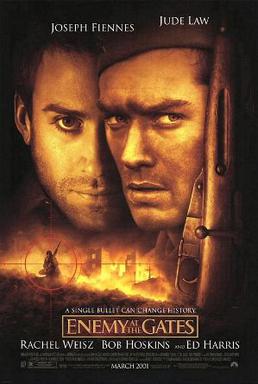
Enemy at the Gates is a 2001 film depicting a highly fictionalised version of the life of Sniper and Hero of the Soviet Union Vasily Zaystev, in this depicted by Jude Law, for, as far as I can tell, no reason at all. He doesn't even try to replicate (nor do many, or even any, other characters in the film) a russian accent, something which Call of Duty has taught us you can hire any big name western actor to do and it will obviously work. Speaking of Call of Duty, actually. If you're familiar with the games then parts of Enemy at the Gates will look very similar. And for good reason. It would certainly seem that Spark Unlimited and Treyarch have both seen the film, and their Stalingrad levels have had moments based off of it. Or, at risk of sounding overly aggressive towards the developers, ripped bloodily from the film as it kicked and screamed. Not that that's a bad thing, if anything it brought a smile to my face as I saw the impact different media forms could have on each other in motion.
Look Familiar?
Though references existing in a certain game series aside, Enemy at the Gates is well worth a look if you're a fan of the genre, particularly World War 2 movies such as Saving Private Ryan and others.You'll eventually end up ignoring that everyone sounds like they're from any given part of London, and be drawn away in the excellent crowd scenes, with various shades of brown and grey being contrasted vividly by the red banners being held by the charging Soviets. These scenes, displaying brutal (though inaccurate) battles in the streets of Stalingrad are likely the film's best, comparatively the scenes of sniping and hunting are slower paced, and quite frankly on the dull side, the build-ups to a shot or a death are a relief from this boredom, but the moment itself feels anti-climactic and everything in-between is just as bad. Some thrill may be found in the scenes following the propaganda that makes Vasily the hero he is, though again, it pales in comparison to the battle scenes at the start of the film, the way the film leads up to his status is interesting, however, though not explored too much.

The acting, in an all round sense is good, the characters feel believable with the possible exception of Vasily himself, who feels like Jude Law. I've already mentioned the lack of Russian accents throughout the film, and I never really got the feeling that anyone in this film was a grim, determined soldier of the Red Army, fighting for their life, and even though you stop noticing the lack of accents so much, it always feels like they'd be more at home in the Ritz than on the streets of Stalingrad. It's not too off putting as long as you push it to the back of your head, but as soon as it crawls to the front, it's hard to drop again. A few characters also needed far more screen-time and development, the most obvious example here being Ron Perlman's veteran sniper, disillusioned with the Communist regime who is, annoyingly, killed about ten minutes after his introduction. It's really a bit of a waste, especially given how interesting the character was to begin with. But nope, he gets shot.

I guess, in the end, as I said at the beginning, the movie is worth watching, it's good, not too great, but good, the score is wonderful to hear, the crowd scenes are utterly brilliant, and you really get a feel for the battle, but it can be brought down by the duller scenes, bad characterisation at certain points (all you ever really get from Vasily himself is that he's a Shepherd from the Urals and he can shoot things) and a few problems with accents. Though all of this isn't enough to make the film bad, or even 'meh', they just bring it down to good, it's a fun watch, an entertaining way to kill a few hours and if you're a fan of World War 2 movies then you should definitely see it if you haven't already.

Friday, 15 October 2010

That's the power of love

Bioware announced this week that gamers that pre-order Dragon Age 2  before January 11th 2011 will receive an upgrade to the 'Signature Edition' with no extra charge and an extra $20 of content. This is good news, as well as it rolling seamlessly into EA's project ten dollar, I love getting free stuff with my games. And I love Bioware and Dragon Age, so, hurray. Anyway, signature edition includes a downloadable soundtrack, a new playable character (Party character, I guess) as well as downloadable items and such for in the game. It's also bundled up in a neat looking package.

So in other news, we're getting Red Dead Redemption: Undead Nightmare a lot sooner than I had assumed, and will be available in disc form for those without an internet service for their console, the DLC should be released in time for Halloween and promises another five hours of zombie fun, as well as a multiplayer mode which sounds a lot like Halo's Firefight meets Left 4 Dead meets Clint Eastwood.

All we wanna do is eat your brains.

Sunday, 10 October 2010

Forever and ever and ever...

Goodness me, is that the time? I almost got lulled into the bliss of the weekend far too much to remember to post something, so, whilst I got Castlevania: Lords of Shadow on Saturday (expect more from that perhaps next week) and it's so far proving to be a lot harder than I'd given it credit for when I was selecting difficulty, one can only tremble in fear as they imagine what 'Paladin' difficulty must be like.

Anyway, before I jump to my main feature of this post, allow me to point out that, the tag at the bottom will correspond to all things related to my college work, and will probably be the only time I bother to add a tag, in fact. So to make sure said tag isn't wasted: I'm currently modelling a Browning M2 Heavy Machine Gun as part of my 3D modelling unit, I'll post a few pictures when I can, getting a wip would be difficult at this time.

Now, hopefully your attention hasn't wandered by the time it's taken you to get to this paragraph, so. Duke Nukem Forever. The Chinese Democracy of the gaming world, and like said album, it seems like it will actually come out... eventually. The lucky people who went to the gaming con Firstlook in Amsterdam got treated to the following gameplay.


So, what have we learned?

- People get damned annoyed if you shut off a game to stop them from watching someone urinate. They've waited twelve years to see that, damnit!
- Whiteboards will never be as fun again, not to mention it appears to be rather hard to draw a circle with a controller for Steve there.
- Phallus = Brilliant tactical plan.
- Don't send SWAT against robot monsters (when did this ever seem like a good idea?)
- Duke is a gamer?

That's all I really have for this post, other than that, Battlefield has gotten me into some 1960's music, listening to a good deal of CCR and Buffalo Springfield at the moment.

I'll be back in another twelve years!

Thursday, 7 October 2010

Blast from the past

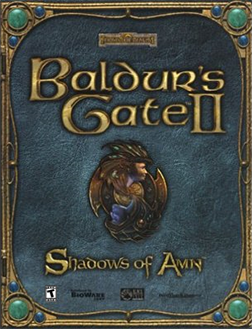
My mention of how I hate Mass Effect style dialogue wheels has brought something up in my memory, possibly what I consider the zenith of RPG games. This gift from the gods that I speak of is Baldur's Gate II: Shadows of Amn, and all things considered I felt it was about time for a retrospective review of the game.

Released to critical acclaim in September 2000 by the Black Isle studios, and developed by RPG moguls Bioware, the Baldur's Gate games were a shining example of how wonderful the two's partnership could be, the second, tweaked and improved, game following on not long after the first left off, even with the option to import your previous game, something often seen in RPGs today.

Usually I would give a synopsis of the story as it begins, but everything screams 'no' within me at this, all I can bring myself to say is how the first game starts; you take the role of a character of your own creation, who has been brought up by his or her adoptive father in the closed off, scholar filled walls of Candlekeep, a town so obsessed with knowledge that one must donate a rare book to their extensive library before they will be allowed entrance. All you know is that your father is planning to take you on a journey, something which he has been keeping very secret, and that you must finish what studies you can as well as buy some road worthy equipment before you meet him. So begins what, in this writers opinion, is the greatest series of RPGs ever made.

I don't want to dwell much on the story, however, as I believe that in this case it must be played through and experienced, in whatever form it may take. So I must move on to what is usually my last resort when reviewing a game; the graphics. I've bumped this up my list of priorities because, well, they're beautiful. Not just by the standards of the early millenium, where every 3D character looked more like a series of cubes stuck together, I mean the game could most likely stand up on its graphics today, people would complain about the isometric viewpoint and the lack of ability to customise your characters cheekbones, I'm sure, but the graphics themselves are timeless, and whilst the character sprites may give away the games age, everything about the environments, the colours, the contrasts, the textures, gives off a beautiful, if slightly aged look, almost like the art deco of gaming. I must admit, it's not often I'll gush over the graphics of even a new release, a comment, perhaps, but nothing too interested, but then, when these games are past their tenth birthday, like Shadows of Amn is, will we look back on them the same way? Or will they seem like crude crayon drawings when compared to the probably photo-realistic graphics we'll have by then.

A brief skim over the essential gameplay mechanics because, really, that's not what I'm here to talk about, the same system was used in 2009's Dragon Age: Origins and, well, frankly it has aged terribly, being auto-paused just in case you want to reassess your strategy every time you take a bit of damage got annoying even at the time, and though watching your party destroy whatever enemy you were against with a flurry of spells and abilities that left the entire battlefield devastated would feel oh-so rewarding, sometimes it just wouldn't be worth the effort when you would mostly be fighting bandits. So no, combat is not what we want to talk about, what we want to talk about is characters and their interaction, the partial voice acting in the game was an impressive addition when it came out, though games such as Deus Ex (2000 as well) boasted the full voice-acting, and even limited dialogue options, that most games have today, the sheer amount of dialogue to be had in Baldur's Gate blew it out of the water, the way characters would interact within your party independent of you, or stop to question you on some matter, and the answers boiled down to more than the bog standard 'saint, neutral, jerk' options that I loathe about the dialogue wheel. At one point you could even claim you were on a quest to find 'the holy ground-hog'. Even if the game did use an utterly superfluous alignment system, it was more of an aid than anything, if you really wanted you could make a Lawful Good character who insulted people at every opportunity, it would be pointless and I'm not sure why you'd want to, but you could do it.

It was this freedom that made Baldur's Gate seem so wonderful, perhaps lacking when compared to more modern, open worl games such as Morrowind and Oblivion, but something to be commended for its time, and a brilliant demonstration of how the RPG genre should be.

Definately well worth whatever pittance is being charged for the entire series in one pack.